The Soemtron ETR222 Calculator
Skip to navigation |
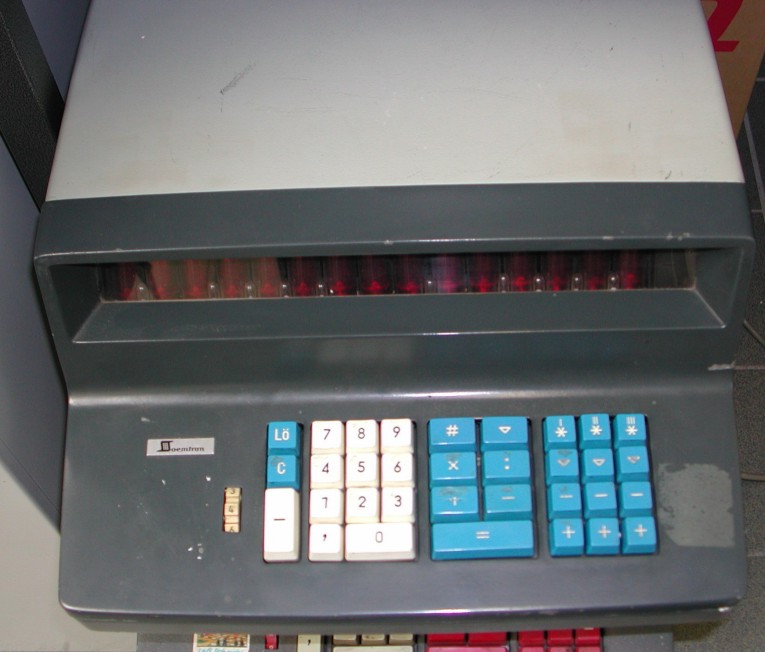 Soemtron ETR222 ©2007 Serge Devidts Click image for a larger version |
Manufactured from 1970 to 1972 by V.E.B.[1] Büromaschinenwerk[2] Sömmerda, 3,203[3] Soemtron ETR222's desktop calculators[4] were built during the two year production run from 1970 to 1972. With seven functions[5], the processing logic of the Soemtron ETR222 calculator, derived from the ETR224, is all transistorised, consisting mostly of pairs of PNP Germanium transistors with a few resistors, capacitors and diodes coupled as Flip Flops (latches) with further sets of diodes for gating functions.
The keyboard is large and cumbersome, non-multiplexed, utilising large microswitches (thought to be V23's[6]) with external supplementary return springs for the keys themselves. The unit has three memories for intermediate calculations, each with their own set of Add, Subtract, Recall, and Recall/Clear keys, there is also a "C" key which clears the current entry and a "Lö" key which clears everything excepting the three operand stores. The multiplexed display of 15 digits is based on Z570M "Nixie" tubes and uses a supply of around 180V.
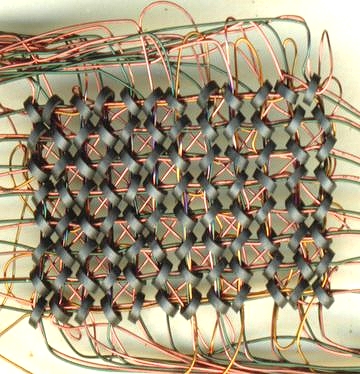 Soemtron ETR222 core store ©2007 www.robotrontechnik.de Click image for a larger version | |
Decimal point selection is by a 12 position thumb-wheel switch to the left of the main numeric keypad and is indicated on the display by small incandescent lamps between most of the Nixie tubes giving the impression of a comma, whilst a range of decimal point selection signals are fed back to the logic circuits for use during calculations. This makes the Soemtron ETR222 a "fixed point" machine rather than the usual "floating point" form found on modern calculators
Memory in the Soemtron ETR222 is a "Ferritkernspeichern"[7] or magnetic core memory consisting of four planes (BCD) of 6 x 16 digit registers, a total of 384 bits or 48 bytes, showing the age of the machine from a time when magnetic core memory was THE "modern" technology before the advent of multi-megabyte semiconductor RAM. Over the two year production run for the 222, 144Kb of magnetic core storage or nearly 1,152,000 miniature ferrite cores were hand threaded onto probably hundreds of kilometres of copper wire.
To date we have found that very little information exists about the Soemtron ETR222. Currently we think that possibly only nine Soemtron 222's remain in the wild -
| 1. | Our machine currently undergoing restoration in the www.soemtron.org collection. February 2024 - we have done further work on our ETR222 and now have the power supply operational and are able to enter digits from the keyboard, however it does not calculate properly, it does do something though !. |
| 2. | There was one at the Digital Computer Museum in a German on-line museum of digital equipment, a photo existed of their ETR222, however as of July 2020 the links seem to be not working. |
| 3. | One owned by Serge Devidts on his website, his ETR222 is presumed non-operational. |
| 4. | An email from Steffen Kreuzberg in Germany has let us know of his non-operational ETR222. |
| 5. | Rolf Carl from the Historisch-technisches Museum in Sömmerda has recently emailed us about a 222 they are currently working on. |
| 6. | Early 2020, another email from Manfred Böhm has let us know of his fully working ETR222 (S# 74775). Manfred has forwarded a few photos and a video of the machine, all can be seen here. |
| 7. | February 2024, in an email from Wolfgang Robel has said that he has received an ETR222 (S# 74013) to go with his ETR220. Currently the machine is non-operational but he hopes to start working on it in a few weeks. |
| 8. | August 2024, an email from Rüdiger Kurth lists a non working machine in the Rechenwerk Museum at Halle (Saale) near Leipzig. |
| 9. | March 2025, this month Michael Feige has let us know of the arrival of his ETR222 (S# 74473), unfortunately not working, but Michael is currently working to get his 222 functional again. This machine may be from the same manufacturing batch as the one owned by Manfred Böhm in #6 above. |

If you have any further historical information, circuits, drawings, photographs, data or manuals about the Soemtron ETR220, 221, 222 and 224 or their manufacture, test equipment (Prüfgeräte) or you just know more about the Soemtron companies in general then please let us know, contact us.
| 1 | Wikipedia entry for V.E.B. = Volks Eigener Betrieb, or Peoples Owned Company | V.E.B.[top] |
| 2 | Büromaschinenwerk. | Office Machine Works.[top] |
| 3 | ETR222 production of 3,203 during 1970-1972 | Page 389 "BWS Sömmerda", by Annegret Schüle ISBN 39-8039-311-9, ©1995 Desotron Erfurt.[top] |
| 4 | Desk top calculator Calculator. |
Tischrechner, rechenmaschine.[top] |
| 5 | Functions | Return constant, exchange operands, Negate number, Add, Subtract, Multiply, Divide.[back] [top] |
| 6 | V23 microswitch | Originally thought to be a V23 microswitch variant, the correct style is the ABB or Petercem, M & CM style switches (data sheets ABB, Petercem), but with right angle PCB pins. Data for these particular right angle PCB mount switches however, does not seem to be available even though they are from the M/CM range.[back] [top] |
| 7 | Ferritkernspeichern | Ferrite Core Memory.[back] [top] |
Site design ©2007- - privacy -