PDP-7
S#2
S#33
S#34
S#41
S#47
S#103
S#104
S#109
S#112
S#113
S#114
S#115
S#118
S#126
S#129
S#148
S#150
FlipChip
History
Options
Teletypes
The Digital Equipment Corporation PDP-7
Skip to navigation |
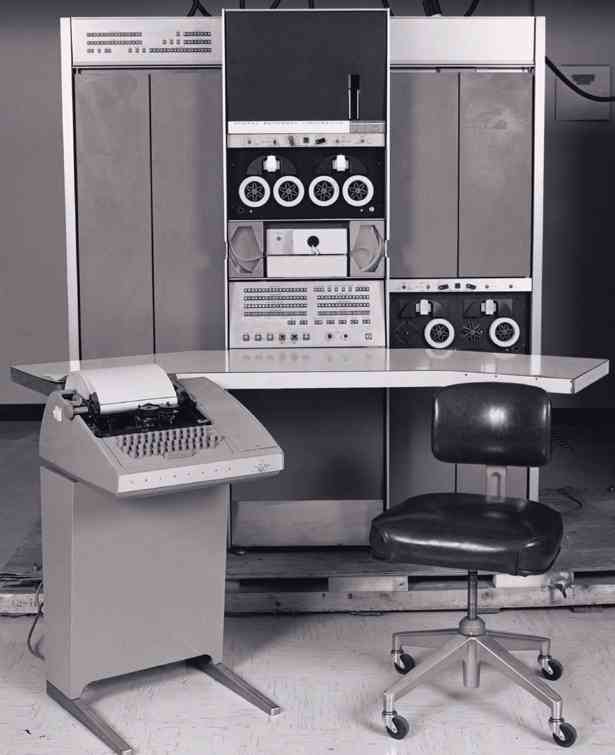 PDP-7 sales photo |
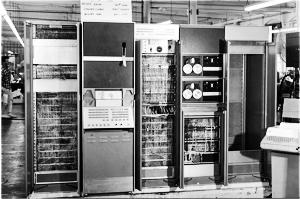 A PDP-7/A in manufacture (Concord Control Corporation) |
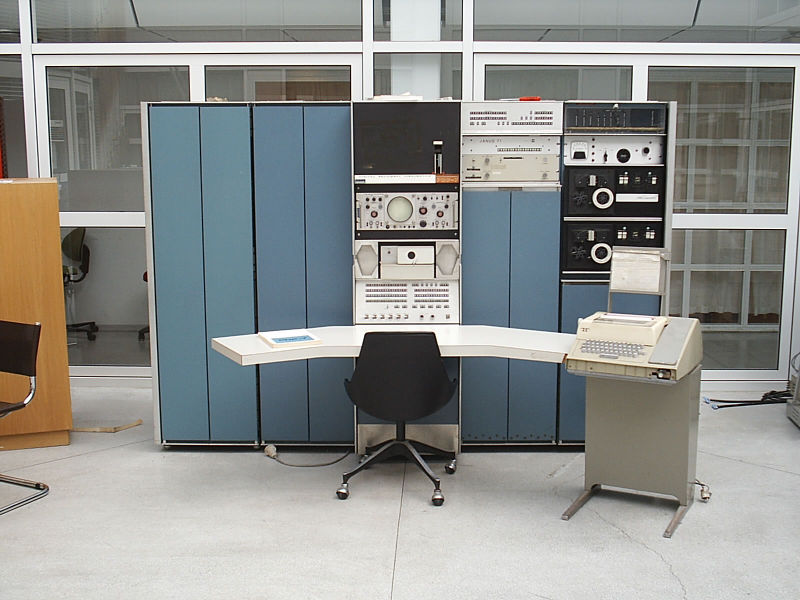 PDP-7/A S#115 undergoing restoration in Oslo Norway ©2009 Tore Sinding Bekkedal |
1964-65 saw the delivery of the third design in Digital Equipment Corporation's series of 18-bit computers[1] - the PDP-7, the first of their computers to use "FlipChip" technology. A later PDP-7 revision, the PDP-7/A, was produced using R series modules, and at the end of production a total of 99[2] PDP-7 and PDP-7/A systems had apparently been shipped. As a minicomputer the PDP-7 had a cycle time of 1.75 microseconds[3] and an add time of 4 microseconds, I/O included a keyboard, printer, paper-tape and dual transport DECtape drives (type 555). Of the original sales target of 120 PDP-7 systems, quite a number were used in laboratory and data acquisition applications and it remained in production for five years. DEC provided an "advanced" Fortran II compiler, a Symbolic Assembler, Editor, DDT Debugging System, Maintenance routines and a library of arithmetic, utility and programming aids developed on the program-compatible PDP-4.
The PDP-7 was developed as a less expensive alternative to the earlier PDP range and it had an introductory price tag of only $72,000 for a minimal system configuration (options list). Utilising core memory as did most machines of its era, the PDP-7's 18-bit memory started at 4K words, upgradeable in 4K chunks to a maximum of 64K, a miniscule amount by today's standards! There was range of I/O units available including Calcomp plotters, DECtape magnetic tape, paper tape readers and high speed paper tape punches, a DEC 340 CRT display unit and the ubiquitous Teletype ASR33.
The PDP-7's claim to fame was forged around 1969-70 when Ken Thompson used a scavenged PDP-7 at Bell Labs, the research arm of AT&T, to develop the operating system that later became Unix. (From the 18-bit Service list this would appear to have been one of PDP-7's #3, #34, #44 or PDP-7/A S#149.
PDP is an abbreviation for Programmed Data Processor, coined by Digital Equipment Corporation and a Boston venture capital company American Research and Development. There was a perceived view at the time that with a limited world market for "Computers" of just a few hundred, of what were seemingly big and expensive machines requiring a dedicated computer centre and a large supporting staff, the term "Computer" should be avoided as there was no money to be made in computers! (doh!), and so was born the PDP - the "Programmed Data Processor".
December 2019 - Of the supposedly 120 PDP-7's originally built (99 traceable) only four had been confirmed to exist in the wild, with only one being in an operable condition. However as of November 2019 several sources have contacted us to let us know of a 5th machine that has been recently donated to, and installed at, The Living Computer Museum (Seattle, Washington) and that it is now running Unix V0. Originally delivered to Boeing it is believed that the Boeing Development Center’s PDP-7 was interconnected with an SDS 940, forming a system to display processed data. There is only one PDP-7 listed at Boeing in the DEC PDP-7 service list, that being machine #129, a PDP-7A, delivered in August 1966 and listed as "Boeing Co. #2", the list does not appear to have a "Boeing #1". See link #5 below.
Interestingly there was another PDP-7 interfaced to an SDS (Sceintific Data Systems) computer, that was the UK Ministry of Works NGTE (National Gas Turbine Establishment Pyestock) SDS9300 which was linked to their PDP-7 S#41 via a custom interface.
- S#47, is a minimal configuration system at a museum in Australia owned by Max Burnet, who has kindly provided photos and information about the system and DEC Australia in general. The Computer History Museum (Mountain View, California), also have several photos of PDP-7 systems in manufacture including two views of #47 that was shipped to the Australian Atomic Energy Commission.
- S#113, at the University of Oregon was operated by Dr. Harlan Lefevre until his retirement when it was decommissioned and donated to the Paul G. Allen PDPplanet collection. It is believed this machine was still fully operational after nearly 40 years with some 65,000 hours (or 7½ years continuous) of use logged[4]. It was due to be recommissioned in 2009, however this was eventually completed during 2010, see the Living Computer Museum website, (as of July 2024 this site is offline). We have since heard that the LCM has ceased operation.
- S#115, is apparently undergoing restoration in Oslo, Norway by Tore Sinding Bekkedal, but it is believed that as this machine had most of its guts modified to TTL 74 series logic at some point in its life, which was then recovered when the machine was decommissioned, bringing it back to full operation was not possible.
- S#33. Rumours of a fourth PDP-7 system at the Computer History Museum have now been confirmed as true following an email from Len Shustek, chairman of the museum. The museums online entry for this machine is online. This machine is listed as being from Massachusetts General Hospital so would have been either PDP-7 S#33 or PDP-7/A S#103, from the photos we suspect it is #33.
- S#129. PDP–7 S#129 was donated to the Living computer Museum in Seattle by Fred Yearian, a retired Boeing engineer.
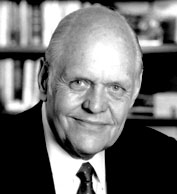
6th February 2011 - Ken Olsen.
We have received the sad news that Ken Olsen co-founder of Digital Equipment Corporation, has died at the age of 84. Digital Equipment Corporation during the 1960's through to the 1980's was one of the major players in the computer industry with their range of PDP and VAX series computers. Ken died on Sunday, February 6, 2011. He would have been 85 years old on February 20. Our condolences to Ken's family. (Obituary, copy).
Links -
| Tore Bekkedal, (as of July 2020 this site is offline) | Restoration of a PDP-7 in Oslo. |
| PDP-7 data | Possibly the largest archive of PDP-7 data available. |
| Unix history | Origins and History of Unix (Wikipedia). |
| History | Unix - "The famous PDP-7 comes to the rescue". |
| Wikipedia | PDP-7 entry at Wikipedia. |
| PDP-7 Service list | Details of the known 99 PDP-7 systems built (1972). |
If you know of any more information about the PDP-7, options, location of existing systems, spare parts, ancillary bits, software, tapes or manuals, then please let us know.
Further reading on PDP-7 history and design.
Our own library of PDP-7 information.
PDP-7 Service list (1972)
The following list information was compiled from Digital Equipment Corporation's 1972 18-bit Customer Service List (kindly supplied by Bob Supnik), available as a download (6.5Mb pdf), and lists the 99 known PDP-7 and PDP-7/A systems on the list in 1972. 120 systems were forecast to be built in total, but at this time we do not have any further information about the possible remaining 21 systems or if they were even built. The PDP-7 appeared to have sold well into Government research and University sectors with 11 systems shipped to the UK alone, almost 10% of the forecast production run! Serial numbers are concurrent for both PDP-7's and the PDP-7/A's giving 102 systems shipped but with three missing in the list. The missing 21 could be of either type; however we are now confident that the 99 systems shipped were the only ones ever built.
Systems in green are systems existing today in museums or private collections, although not necessarily in an operational state. Two machines however, S#113 and S#129, have been restored and are now fully operational and open to public viewing at the Living Computer Museum website, (as of July 2024 this site is offline). We have since heard that the LCM has ceased operation. The 18-bit Customer Service List covers PDP-7 S#1-50 with S#22 and S#46 missing and PDP-7/A's S#101-152 with S#125 missing, making it 99 systems shipped of the potential 102 serial numbers.
| PDP-7 | |||
| S# | Shipped | Customer | |
| 1 | - | DEC prototype | |
| 2 | 04/1965 | Stanford University (Palo Alto, California USA) - info | |
| 3 | 11/00 ? | Bell Telephone Labs (USA) | |
| 4 | 01/1965 | R Boisurt (?) | |
| 5 | 04/00 ? | New York University (USA) | |
| 6 | 04/1965 | TH Delft (University of Delft, The Netherlands) | |
| 7 | 02/1965 | Elliot Cambridge (UK) | |
| 8 | 04/1965 | Holloman A.F.B. (New Mexico USA) | |
| 9 | 05/1965 | Rensselaer Polytechnic (Troy, New york USA) | |
| 10 | 04/00 ? | Fort Belvoir (Fairfax County, Virginia USA) | |
| 11 | 10/00 ? | Oxford University (UK) | |
| 12 | 05/1965 | Tekniska Högskolan (Helsinki University of Technology, Sweden) | |
| 13 | 05/1965 | Pittsburgh University (which one? Pennsylvania USA) | |
| 14 | 04/1965 | Foxboro Pureto (Puerto) Rico | |
| 15 | 05/1965 | Jet Propulsion Laboratory (Pasadena, California USA) | |
| 16 | 05/1965 | Argonne National Labs (Argonne, Illinois USA) | |
| 17 | 08/1965 | University of Texas (Austin, Texas USA) | |
| 18 | 05/1965 | Carnegie Tech (Carnegie Mellon University? Pittsburgh, Pennsylvania USA) | |
| 19 | 05/1965 | Massachusetts Institute of Technology Lincoln Labs (Lexington, Massachusetts USA) | |
| 20 | 05/1965 | Battelle Northwest (Pacific Northwest National Laboratory, Richland, Washington USA) | |
| 21 | 05/1965 | Battelle Northwest (Pacific Northwest National Laboratory, Richland, Washington USA) | |
| 22 | ? | No information available | |
| 23 | 07/1965 | Jet Propulsion Laboratory (Pasadena, California USA) | |
| 24 | 08/00? | Massachusetts Institute of Technology #2 (Lincoln Labs? Lexington, Massachusetts USA) | |
| 25 | 08/1968 | Manchester University (UK) | |
| 26 | 08/1965 | Alabama University (Tuscaloosa, Alabama USA) | |
| 27 | 07/1965 | Stromberg Carlson (Telecommunications? Rochester New York USA) | |
| 28 | 07/1965 | WPAFB / AZERP #1 (Wright-Patterson Air Force Base? Ohio USA) | |
| 29 | 12/1965 | Foxboro (Puerto Rico? S#14) | |
| 30 | 09/1965 | Massachusetts Institute of Technology Lincoln Lab MONT (Lexington, Massachusetts USA) | |
| 31 | 09/1965 | LRL Berkeley (Lawrence Radiation Laboratory, Berkeley, California USA) | |
| 32 | 09/1965 | Lear Siegler (California? USA) | |
| 33 | 07/1965 | Massachusetts General Hospital #1 (Boston USA) - info | |
| Either this machine or S#103 is now at the Computer History Museum collection in Mountain View, California - CHM website | |||
| 34 | 01/1969 | Bell Telephone Labs (USA) | |
| Recent research by Warner Losh in his blogs #1 and #2 have shown that this PDP-7 at Bell Telephone Labs is the one that Ken Thompson and Dennis Ritchie "scrounged" and then used to develop UNIX. | |||
| 35 | 10/1965 | University of Illinois (Champaign? Illinois USA) | |
| 36 | 10/1965 | Jet Propulsion Laboratory (California Institute of Technology? Pasadena, California) | |
| 37 | 12/1967 | US Naval Ordinance | |
| 38 | 08/1968 | US Government | |
| 39 | 12/00? | Tennessee University (Knoxville Tennessee USA) | |
| 40 | 12/1965 | Module test | |
| 41 | 11/1965 | Ministry of Public Buildings (UK Government N.G.T.E Pyestock) - info - website | |
| 42 | 11/1965 | Aachen #1 (Aachen Technical School? Aachen, Germany) | |
| 43 | 11/1965 | LRL Livermore (Lawrence Radiation Laboratory, Livermore? California USA) | |
| 44 | 11/1965 | Bell Telephone Labs (USA) | |
| 45 | 12/1965 | Hershey Medical Centre (Hershey, Pennsylvania USA) | |
| 46 | ? | No information available | |
| 47 | 01/1966 | Australian Atomic Energy, Lucas Heights - info | |
| This machine is now in the private collection of Max Burnet in Australia | |||
| 48 | 01/1966 | Jet Propulsion Laboratory | |
| 49 | 01/00 ? | University of Heledelberg FSIC (Heidelberg Germany?) | |
| 50 | 05/1966 | Foxboro | |
| PDP-7/A | ||
| S# | Shipped | Customer |
| 101 | 12/1969 | Bob Reed |
| 102 | 08/1968 | University of Rochester (Rochester USA) |
| 103 | 01/1966 | Massachusetts General Hospital #2. (Boston USA) - info |
| Either this machine or S#33 is now at the Computer History Museum collection in Mountain View, California - CHM website | ||
| 104 | 01/1966 | Massachusetts Institute of Technology, project MAC - info |
| 105 | 01/1966 | University of Freiburg (Freiburg, Germany) |
| 106 | 01/00 ? | Liverpool University (UK) |
| 107 | 01/00 ? | Glasgow University (UK) |
| 108 | 01/00 ? | Aachen #2 (Aachen Technical School? Aachen, Germany) |
| 109 | 01/1970 | Massachusetts Institute of Technology ERC (Education Research Centre), Cambridge, Massachusetts USA - info |
| 110 | 01/1966 | Solartron |
| 111 | 02/1966 | Atomic Weapons Research Establishment (A.W.R.E.) Aldersmaston (UK) |
| 112 | 02/1966 | Edinburgh University (UK) - info |
| 113 | 02/1966 | Oregon University - info |
| This machine is now in the Paul G. Allen PDPplanet collection at the Living Computer Museum, Seattle. It completed restoration during 2010 Living Computer Museum website, (as of July 2024 this site is offline). We have since heard that the LCM has ceased operation. | ||
| 114 | 02/1966 | Applied Data Research |
| 115 | 02/1966 | Oslo University, Norway - info |
| This machine is now in the private collection of Tore Sinding Bekkedal in Oslo. It was apparently undergoing restoration but this is believed to have now stopped. (this site is currently offline) | ||
| 116 | 04/1966 | TNO Soesterberg (The Netherlands) |
| 117 | 03/00 ? | Tokyo University Japan |
| 118 | 04/1966 | Worcester Polytechnic (Massachusetts USA) |
| 119 | 05/1966 | DEC training (UK) |
| 120 | 06/1966 | Michigan University (Michigan USA) - info |
| 121 | 05/1966 | Fort Meade #1 (Baltimore USA) |
| 122 | 11/1966 | Fort Meade #2 (Baltimore USA) |
| 123 | 03/00 ? | US Government Virginia |
| 124 | 04/1966 | University of Nijmegen (The Netherlands) |
| 125 | ? | No information available |
| 126 | 05/1966 | University of Cambridge (UK) - info info |
| 127 | 06/1966 | Information Intern |
| 128 | 03/1969 | University of Erlangen (Nuremberg, Germany) |
| 129 | 08/1966 | Boeing Co. #2 - info |
| This machine was recently donated to the Paul G. Allen PDPplanet collection, Seattle. In late 2019 it was used to boot and run UNIX V0. Living Computer Museum website, (as of July 2024 this site is offline). We have since heard that the LCM has ceased operation. | ||
| 130 | 08/1966 | University California LRL (Lawrence Radiation Laboratory? Berkeley California USA) |
| 131 | 06/1966 | University of Pittsburgh (Pittsburgh Pennsylvania, United States) |
| 132 | 06/1966 | DEC training (UK) |
| 133 | 10/1966 | Imperial College (London UK) |
| 134 | 03/1968 | Rome Air Force Base (Italy? or Griffiss Air Force Base? Rome New York USA) |
| 135 | 10/00? | Princeton University (New Jersey USA) |
| 136 | 11/1966 | Fort Meade US Army #3 (Baltimore USA) |
| 137 | 08/1966 | Union Carbide (? USA) |
| 138 | 10/1966 | Timesharing Ltd. (TimeSharing Ltd London UK) |
| 139 | 11/1966 | Yale (New Haven, Connecticut USA) |
| 140 | 11/00 ? | Sandia Corp. (California or New Mexico? USA) - photos 1, 2 |
| 141 | 09/00 ? | WPAFB #2 (Wright-Patterson Air Force Base? Ohio USA)) |
| 142 | 12/00 ? | PGH Plate Glass Co. (Pittsburgh? USA) |
| 143 | 03/1969 | Four Queens Casino O? LAS (Las Vegas? Nevada USA) |
| 144 | 01/1970 | University of California (New York? USA) |
| 145 | 12/00 ? | Langley Porter (UCSF Medical Centre? San Francisco, California USA) |
| 146 | 11/00 ? | University of Paris (Paris, France) |
| 147 | 07/1967 | III (Information International Inc. also Triple-I) |
| 148 | 01/1967 | BBN (Bolt, Beranek and Newman, Boston Massachusetts USA) |
| 149 | 03/1969 | Bell Telephone Labs (USA) |
| 150 | 01/1967 | BBN (Bolt, Beranek and Newman, Boston Massachusetts USA) |
| 151 | 09/00 ? | Digital Circuit Tester |
| 152 | 04/00 ? | Royal Radar Establishment Malvern (UK) |
A full list, to our knowledge, of the available options on a PDP-7 is available.
Miscellaneous DEC information, manuals, data sheets, Etc. mostly for the PDP-7 of course! but there is some PDP-11 and PDP-15 info in here as well.
| Data | Description |
| Brochure 1964 1.1Mb pdf | Brochure F-71 from 1964 entitled - "Programmed Data Processor - 7", a basic brochure of the PDP-7. |
| Brochure 1964 4.8Mb pdf | A more involved DEC brochure from 1964 giving a good basic run down of the PDP-7 computer, its basic operation and options. |
| Logic handbook 1961 5Mb pdf | DEC symbology, Basic digital modules (inverters; diode logic; flip-flops; delays; pulse amplifiers; clocks; pulse generators), Typical applications (counters; parallel adders; comparators; synchronizers; subtracters; Gray to binary code converter), Rules and definitions (inverter usage; loading definitions; marginal checking; indicators), Boolean algebra, DEC Technical bulletins. |
| Logic handbook 1967 26Mb pdf | Logic primer, R B W Series "FlipChip" modules and application notes (32 position decoding; Stepper motor drives; Pseudo random sequences), Logic laboratory, Hardware (panels; cabinets; hardware; connectors; Octaid and Panelaid series modules; E and F Series modules), Analog to Digital Conversion handbook, A Series modules, K Series modules, and a whole lot more! |
| Technicians handbook 1974 3.6Mb pdf | 1974 Technicians handbook from the DEC training department in Galway Ireland. Includes PDP8, PDP11 and IC information. Trouble shooting, General notes, PDP8 family notes, PDP11 family notes, IC datasheet index (DEC numbers; 74xx 8xxx and 9xxx series IC's). |
| Users Handbook 1965 13.5Mb pdf | System introduction, Functional description, Instructions, Basic machine language programming, Processor, Core memory, Standard I/O equipment, Card equipment and line printer, Magnetic tape and drum, Plotter and display, Analog/digital conversion, Data and communication equipment, Operating procedures, Fortran, appendix, illustrations. |
| Users Handbook 1964 7.4Mb pdf | Description, Operation, Central processor, Input/output control and interface, Input/output equipment, Appendix, Illustrations and drawings. |
| Maintenance Manual 1966 20Mb pdf | For PDP-7/A systems (serial numbers 100 and above). Introduction and description, Operation, System, options, Maintenance, Engineering drawings, Power supplies and control, FlipChip modules. |
| 18-bit Architecture 113Kb pdf | Architectural Evolution in DEC's 18-bit Computers. DEC built five 18-bit computer systems: the PDP-1, PDP-4, PDP-7, PDP-9, and PDP-15. This paper documents the architectural changes that occurred over the lifetime of the 18-bit systems and analyses the benefits and trade-offs of the changes made. Written and ©2006 Bob Supnik. (2003 original 90Kb pdf) |
| 18-bit Card readers 34Kb pdf | Card Readers for DEC's 18-bit Computers. Punched cards were never a mainstream medium for DEC systems. DEC preferred punched paper-tape, which used less costly peripherals and simpler interfaces. DEC never seemed to be able to get cards quite right. Nowhere is this better illustrated than in the 18-bit computer line, which implemented seven different card reader options across the five machines in the 18-bit family PDP-1, PDP-4, PDP-7, PDP-9, and PDP-15. |
| Interface manual 4.9Mb pdf | PDP-7 Interface and installation manual. Introduction, Data transfers, Break transfers, Digital logic circuits, Interface connections, Installation planning, Illustrations, Tables. Information in this manual applies only to PDP-7 systems with serial numbers above 100. Refer to the PDP-7 Interface and Installation Manual, F-78, dated 1/66, for information on systems with serial numbers below 100. |
| Maintenance manual 23.5Mb pdf | Core memory, Input/output, Optional equipment, Interface, Installation, Operation, Maintenance, Engineering drawings, Tables. |
| PDP-7/A S#113 10.0Mb pdf | PowerPoint presentation made by Professor Lefevre of The University of Oregon about the history and restoration of their PDP-7/A, now at the Living Computer Museum, as of July 2024 this site is offline. |
| PDP-7 - DEC-388 Display interface 2.3Mb pdf | Dated August 1967, this document (Report #?) contains a description, commands and hardware drawings of a PDP-7 modified for use with a DEC 388 display usually used on a PDP-8. Known locally as the 337 it became the prototype for the DEC 339 display. The document is in the public domain, copyright of this document resides with the University of Michigan, Ann Arbor. |
| PDP-7 - LOCOSS Software manual 6.1Mb pdf | Dated November 1968, this document (Report #10) describes LOCOSS, Logic Of Computer Operating System for the PDP-Seven, developed to provide a run-time environment for application programs. The document is in the public domain, copyright of this document resides with the University of Michigan, Ann Arbor. |
| PDP-7 - IBM 1800 Interface software 4.5Mb pdf | Dated December 1968, this document (Report #11) contains a description of a collection of programs for the PDP-7 to IBM 1800 inter-computer data link including file manipulation, text editors, assemblers and debugging. The document is in the public domain, copyright of this document resides with the University of Michigan, Ann Arbor. |
| PDP-7 - IBM 1800 Interface 1.5Mb pdf | Dated November 1968, this document (Report #12) contains a functional description of the high speed interface. The document is in the public domain, copyright of this document resides with the University of Michigan, Ann Arbor. |
| PDP-7 - IBM 1800 Interface manual 8.6Mb pdf | Dated August 1970, this document (Report #31) contains a description, commands and hardware drawings of a PDP-7 to IBM 1800 inter-computer data link, with basic diagrams. Again, it is not known if this interface existed but the general tone of the report suggests it did. The document is in the public domain, copyright of this document resides with the University of Michigan, Ann Arbor. The University of Michigan had a PDP-7/A S#120, delivered in 1966. |
| PDP-7 - PDP-9 Comms package 2Mb pdf | Dated July 1970, this document contains a description and commands of a PDP-7 to PDP-9 inter-computer data link using a 50 kilobit serial Dataphone link. The document (memorandum 11) is in the public domain, copyright of this document resides with the Massachusetts Institute of Technology. M.I.T. had a PDP-7/A S#104, delivered to project MAC (Technology Square) in 1966. |
DEC 18-bit Computers - [top]
- PDP-1 - 4K-64K of main memory, 5uS cycle time, one's complement arithmetic. Mostly constructed of DEC 1000-series system building blocks rated at 5MHz. Apparently three PDP-1 computers still exist, all in the collection of the Computer History Museum, a prototype, and two PDP-1C machines. The last PDP-1 manufactured (#55) has been restored to working order and is used as a working exhibit.
- PDP-4 - First shipped in July 1962 as a slower, cheaper alternative to the PDP-1, but not commercially successful. One customer of these early PDP machines was Atomic Energy of Canada. The PDP-4 has been implemented by David Conroy in a XILINX field programmable gate array.
- PDP-7 - Replacement for the PDP-4, DEC's first wire-wrapped machine.
- PDP-9 - Successor to the PDP-7, DEC's first micro-programmed machine.
- PDP-15 - DEC's final 18-bit machine. It was their only 18-bit machine constructed from TTL integrated circuits rather than discrete transistors. Later versions of the system were referred to as the "XVM" family. The new machine was faster and less expensive than its predecessors and had the added sophistication of a separate I/O processor to the CPU. Over 400 of these machines were ordered in the first eight months of production. PDP-15's in the collection of Mike Ross
Various information sources on both the internet and in literature gives the total sales of the PDP-7 systems as 120 units, in our research however we have not found any definitive information to substantiate this number. To date the only firm evidence for the number of systems produced is the 1972 18-bit Service list, which shows 99 systems. Unless further information surfaces in the future, which is now probably unlikely, 99 shipped systems it will have to be. [top]
- From the DEC book "Computer Engineering - A DEC view of hardware systems design", it is apparent that the original - sales goal - for the PDP-7 range was 120 units.
The 1978 DEC historical document "Nineteen Fifty-Seven To The Present" copy here, has (on page 6) that "One hundred and twenty PDP-7's were sold altogether", whilst on page 86 in the table of "Installed minicomputer Systems", it lists the PDP-7 as having 115 installed systems at January 1st 1977 with deliveries starting in November 1964. It cites the International Data Corporation EDP Industry Report 22nd April 1977.c
A find in DECuscope Volume 10 1971, the newsletter of the Digital Equipment Users Society, has unearthed an article by A. R. Atherton of the Cavendish Laboratory, Cambridge, England (PDP-7/A S#126), entitled "MODERNIZING A PDP-7", where a new 16K core store was fitted to their PDP-7 and the opportunity taken to reduce the cycle time of the computer from 1750nsec to 875nsec, doubling its speed. A supercharged PDP-7!! [top]
Longevity - DEC PDP-7's were all fitted with a running hour meter recording the number of hours spent in operation. We currently have the values for two PDP-7 systems when they were finally de-commissioned - [top]
- #113, at the University of Oregon - 65,000 hours of use (or 7½ years continuous) logged after nearly 40 years. Delivered in February 1966 and scheduled for removal at the end of 2001, #113 would appear to have lingered on at the University for another five years until finally being moved in June 2006 when it was still in a running condition. This machine is now at Paul Allen's Living Computer Museum (PDPplanet Project) in Seattle. It has been restored and is now fully operational and open to public viewing at the Living Computer Museum website, (as of July 2024 this site is offline). We have since heard that the LCM has ceased operation.
- #47, at the Australian Atomic Energy Commission Lucas Heights - 111,577 hours of operation (or 12¾ years continuous). Delivered in 1966 and retired after 15 years to the museum of Digital Equipment Australia PTY Ltd. run by Max Burnet, the company's general manager. This machine was switched on for over 12.5 years of its 15 year lifetime at Lucas Heights.
Site design ©2007- - privacy -